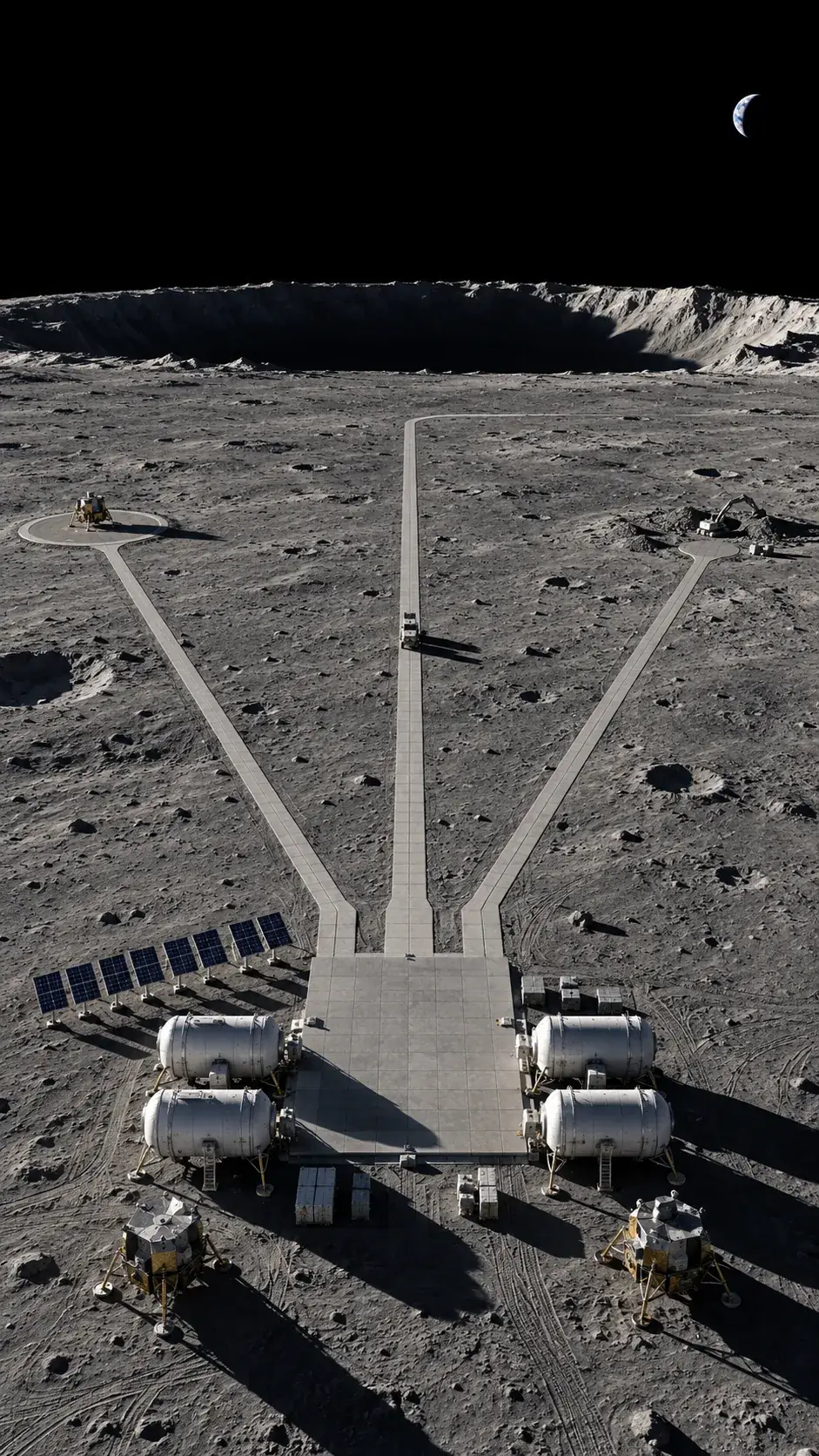
Lunar surface infrastructure / Patents pending
We build roads on the Moon.
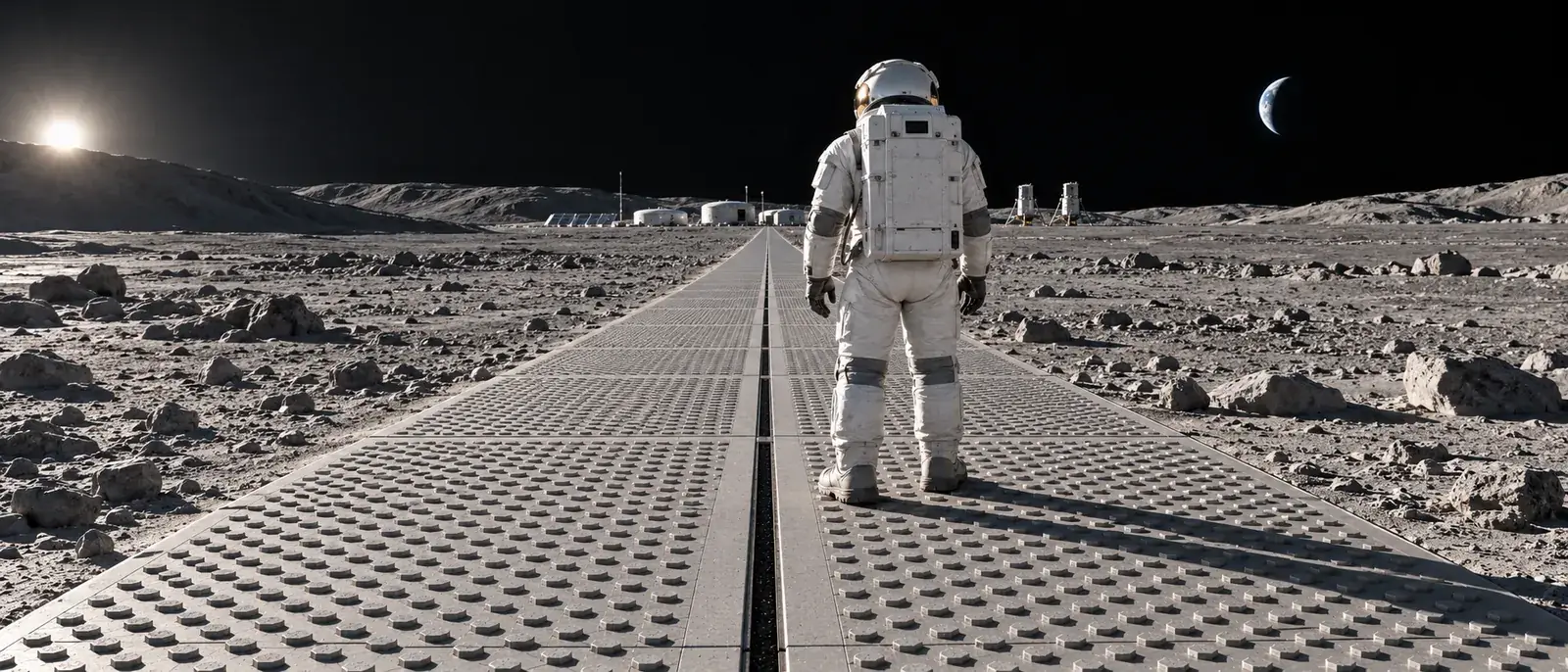
An engineered high-traction surface with integrated vehicle restraint, manufactured on-site from lunar regolith. Nothing launched but the machine.
Concept render · Space Mobility lunar highway · Patents pending
The problem
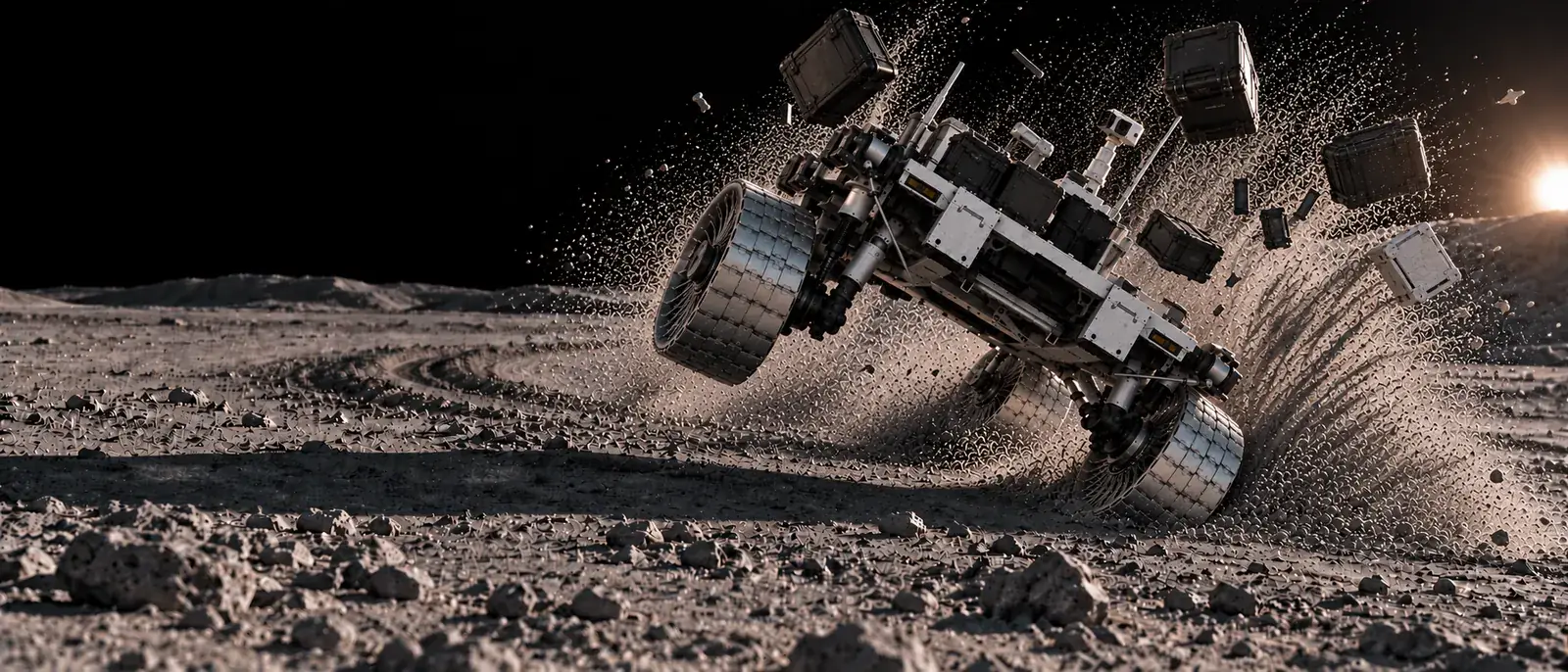
Driving on the Moon is worse than driving on ice.
Concept render · Bare regolith
A tire grips because gravity presses it into the ground. The Moon supplies one-sixth of that. The vehicle keeps all of its mass and momentum, but only a fraction of its grip, so it slides wide in corners, takes the length of a football field to stop, and bounces off every bump.
Bare regolith leaves a rover about 25% of its Earth driving capability. Glare ice on Earth does better. And every wheel turn throws abrasive dust that grinds seals, optics, radiators and suits.
The dust is the problem. The dust is also the material.
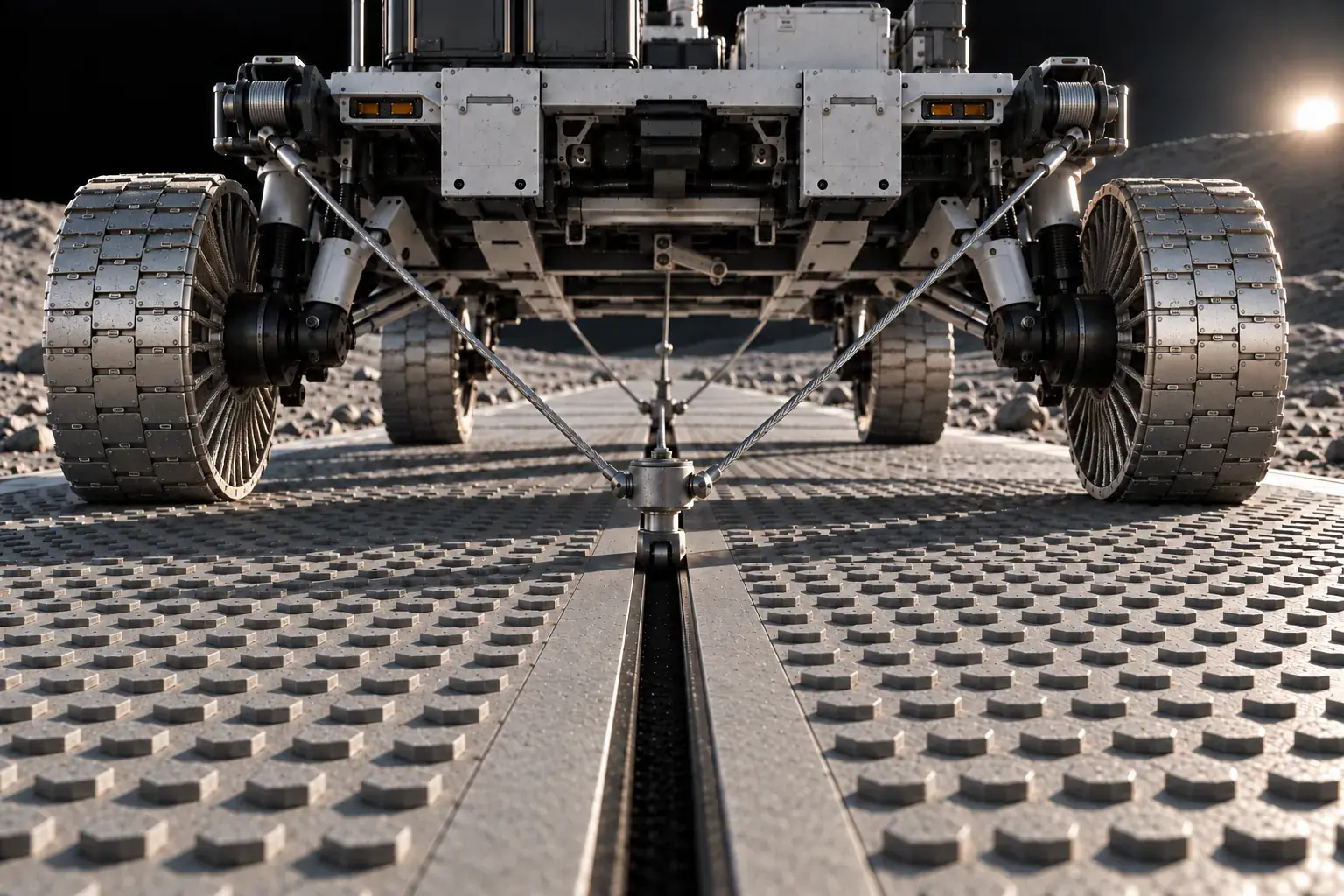
Concept render · Patents pending
Our core idea · Patents pending
Mechanical Gravity
The Moon gives you one-sixth.
The road gives you the rest.
What is Mechanical Gravity?
It is the hold that gravity would normally provide, supplied by the road instead of the planet.
The result: the rover corners, brakes and rides over bumps the way it would at home. And when conditions exceed what the road is rated for, the system lets go cleanly instead of letting the road take damage.
The numbers
The difference, drawn to scale.
A loaded 3.6 t rover at 32 km/h, on bare regolith and on our road.
Safe turning radius
32 km/hStopping distance
from 32 km/hDriving capability
Earth = 100%Basis: a 3.6 t loaded rover at 32 km/h. Percentages are cornering-speed and braking-distance ratios against an Earth reference of 8.83 m/s² (µ ≈ 0.9). Road figures are engineering analysis ahead of ground validation.
The road
One road, five jobs.
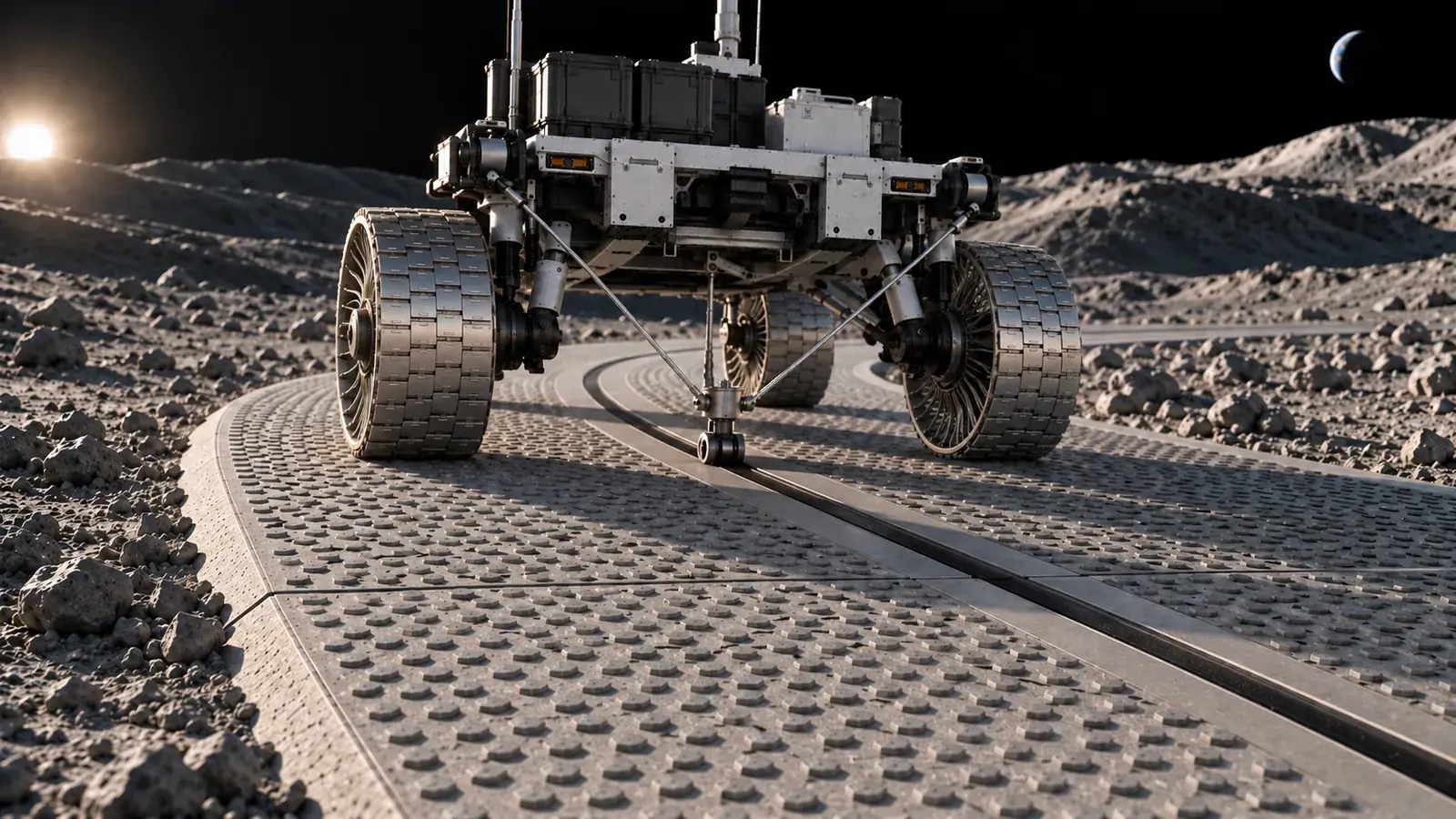
Drive like Earth. Made of Moon.
Concept render · Patents pending
Earth-class handling
Earth-class cornering, braking and ride quality at operational speeds.
Dust-free driving
Wheels never touch loose regolith. A road network is dust mitigation infrastructure.
Built-in navigation
A physical guidance path for autonomy, with no dependence on GPS, lighting or terrain perception.
Power and data corridors
Every road is a corridor for power and data, built in the same pass.
Lasting presence
Permanent infrastructure demonstrates sustained activity under the Outer Space Treaty, without a territorial claim.
Our approach
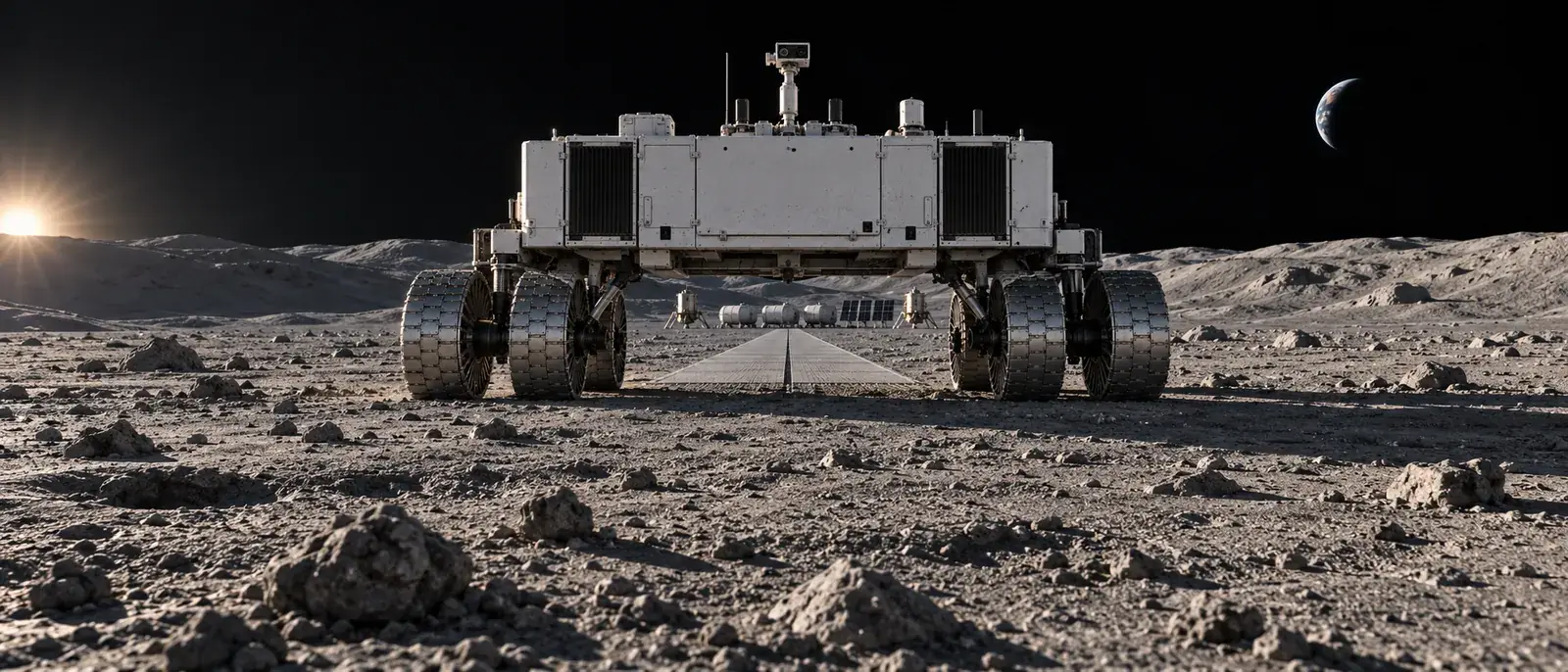
Built from the Moon, on the Moon.
Concept render · Patents pending
Local resources over launched mass. Every kilogram of road made on the Moon is a kilogram not launched.
Infrastructure over symbols. A road is used every day by every mission that follows.
Engineered to last. Designed as permanent infrastructure, maintained in place.
Intellectual property
Protected in layers.
Our U.S. patent filings were completed September 2026, covering the complete road system, from the surface a wheel touches to the connection with the vehicle. They are written for any low-gravity world, not only the Moon.
The manufacturing process from regolith to road is a held trade secret and in the second phase of its validation process.
Roadmap
From the lab to the lunar surface.
Concept render · Patents pending
- 2026 · NOWDesign and patent filingsRoad system engineered and analyzed. Patents pending.
- 2027–28Ground validationFull-scale road elements tested on Earth with partner research institutions.
- 2029–30Subscale flight demonstrationA CLPS-class demonstration on the lunar surface.
- 2031–33Initial productionFirst operational road segments at a lunar base.
Talk to us
Planning surface operations?
Tell us about your mission or program. We typically reply within one business day.
contact@spacemobility.com